
Steep Terrain Specialists
Hillside and Steep Terrain Clearing
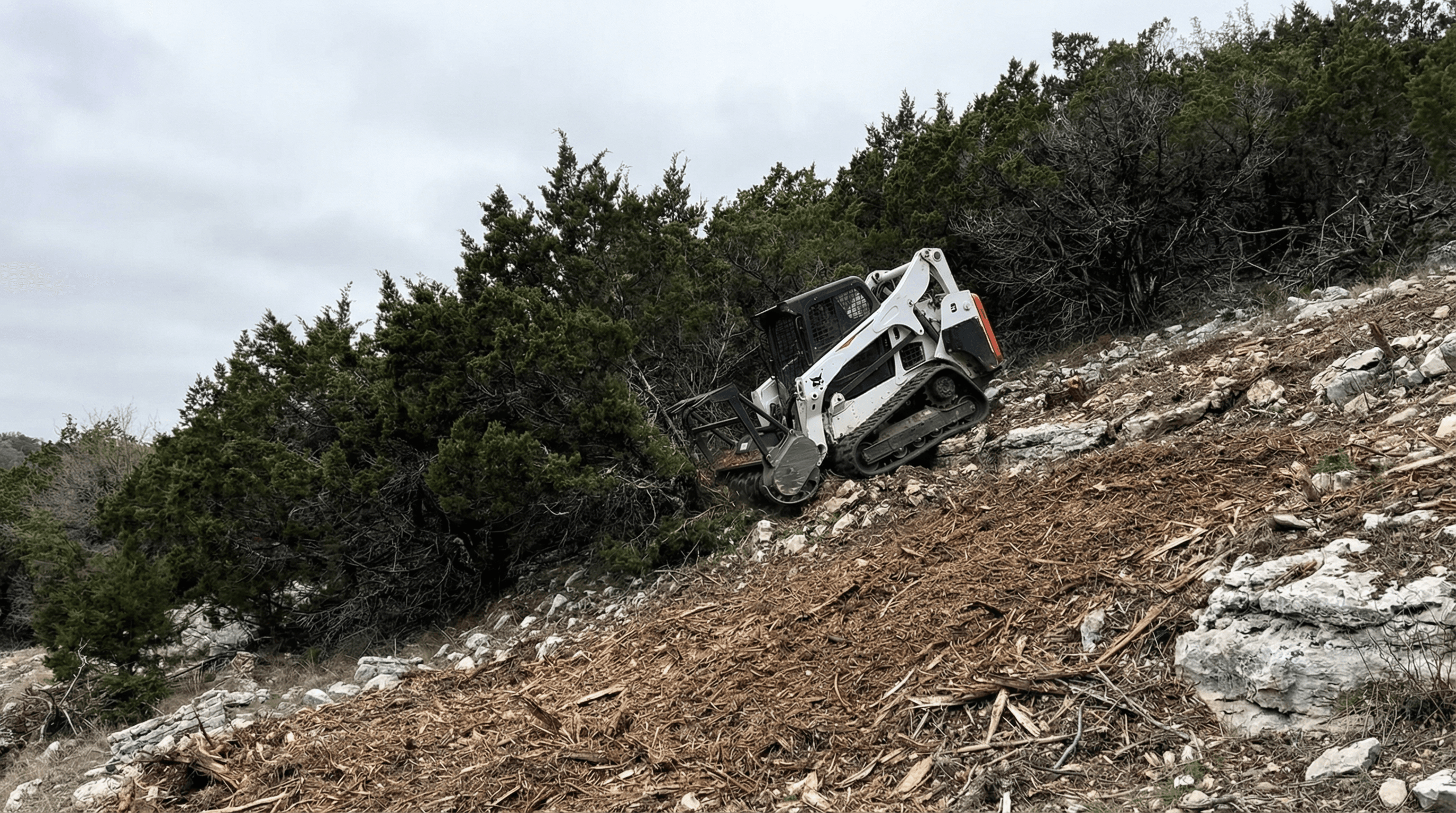
Slopes, rocky limestone, creek banks. The jobs other crews drive past because their equipment can not handle the grade or they are worried about getting stuck. We do not avoid them.
Sound Familiar?
“Two crews already told me they can not do it.”
Western Parker County toward Mineral Wells and Millsap has rolling hills, limestone bluffs, and creek-cut terrain that is nothing like the flat prairie to the east. The ground is rocky. The slopes are real. And the brush that grows on those hillsides — cedar, greenbriar, sumac — is just as dense as anywhere else.
Most land clearing crews run standard equipment designed for level ground. When they see slopes, limestone outcrops, or creek banks covered in brush, they either pass on the job or give you a price so high it is a polite “no.”
That leaves property owners stuck. The brush is not going to clear itself. Doing it by hand on a slope with loose rock and thorny vines is dangerous and painfully slow. Burning on slopes is unpredictable and not something your neighbors want you doing.
This is not flat-ground work. It requires the right equipment, the right operator skill, and a realistic understanding of what the terrain demands. We built our operation around handling exactly these jobs.
How It Works
How We Handle Steep Terrain
Terrain Assessment
We walk the slope in person. Check soil stability, rock density, grade angles, and access points. Some sections may need a different approach than others. You get an honest assessment and a fixed-price quote.
Strategic Clearing
We work slopes methodically — not randomly. Starting position, direction of travel, and equipment configuration all matter on a hillside. Operator experience is the difference between efficient clearing and getting stuck sideways on a grade.
Stabilized Ground
The mulch layer left behind does double duty: it suppresses brush regrowth and prevents erosion on the slope. Root systems stay in the ground holding soil. Your hillside is clear, stable, and usable.
Why It Matters
What Hillside Clearing Gets You
Usable Slopes
Clear views, walkable terrain, and land you can actually use instead of a wall of brush on a hill you can not access.
Erosion Prevention
The mulch layer protects topsoil on slopes better than bare dirt. Root systems stay in place and continue holding the hillside together.
Cedar Removal on Slopes
Eastern red cedar takes over hillsides in Parker County. Removing it restores water to the soil — a single mature cedar drinks 30+ gallons per day.
Creek Bank Stabilization
Clear overgrown creek banks without destabilizing them. Mulch protects the bank surface while you regain access and visibility.
Fire Mitigation
Brush-covered slopes with cedar are extreme fire risks. Wind drives fire uphill fast. Clearing creates defensible space around structures above the slope.
Equipment That Fits
Our machines are configured for slope work. Proper weight distribution and track systems that maintain traction on grades where standard skid steers slide.
Local Terrain
Parker County Hillside Terrain
Limestone Outcrops
Western Parker County sits on limestone bedrock with thin topsoil. The rock is close to the surface and sometimes exposed. This is the hardest terrain to clear — equipment wear is significantly higher, and the operator has to read the ground constantly to avoid damaging the mulcher head on subsurface rock.
We carry extra wear parts on every hillside job and factor limestone terrain into our pricing. If your property is in the Mineral Wells or Millsap area, expect rocky conditions.
Creek Banks and Drainage Areas
Parker County has hundreds of creeks and drainage channels cutting through the terrain. The banks get overgrown with brush that restricts water flow and causes pooling during storms. Dense vegetation also hides active erosion that gets worse with every rain event.
Clearing creek banks requires working on sloped, often soft ground near water. The mulch layer we leave behind is critical here — it protects the exposed bank surface from rain impact and slows runoff while native ground cover re-establishes.
Real Talk
Why Hillside Work Costs More
We are not going to pretend hillside clearing is the same price as flat-ground work. It is not, and any crew that quotes it that way is either underestimating the job or planning to cut corners.
Here is what drives the premium:
Slower operating speed — you cannot push a mulcher at full speed on a slope without risking rollover or loss of traction
Higher equipment wear — rocky terrain chews through mulcher teeth faster, and working on angles stresses hydraulic systems
More fuel consumption — the machine works harder on inclines, burning more diesel per acre cleared
Operator skill premium — hillside work requires experienced operators who read terrain and make real-time decisions about approach angles
Access challenges — getting equipment to and from hillside work areas sometimes requires building temporary access paths
The result is a higher per-acre cost than flat terrain. But you are paying for the job to get done right, safely, on ground that most crews will not touch. Visit our pricing page for general rate information.
Common Jobs
Typical Hillside Clearing Projects
Hillside cedar removal — eastern red cedar dominates slopes throughout western Parker County
Creek bank clearing for drainage improvement and erosion visibility
Slope clearing for home sites on hilly acreage where the best views are uphill
Pasture reclamation on rolling terrain where brush has taken over grazing land
Defensible space clearing around homes built on hilltops or ridge lines
Access road clearing through hilly terrain to reach back sections of large properties
Setting the Record Straight
“Won't clearing cause erosion on my hillside?”
This is the most common concern we hear about hillside clearing, and it makes sense. Bare dirt on a slope erodes. That is basic physics.
But forestry mulching does not leave bare dirt. The entire point of the method is that cleared material becomes a ground cover layer of mulch, 3-4 inches thick, spread across the slope surface.
That mulch layer absorbs rain impact, slows surface runoff, and holds soil in place. Meanwhile, the root systems of the cleared brush stay in the ground. They continue to hold soil for months as they decompose, giving native grasses and ground cover time to re-establish.
Traditional clearing methods — bulldozing, root-raking — do cause erosion because they scrape the surface bare and rip out root systems. Forestry mulching does the opposite. It is the right method for slopes specifically because it protects the soil surface while removing the brush above it.
Frequently Asked Questions
Got a hillside other crews won't touch?
Send us the address and a description of the terrain. We will walk it, assess the slope, and give you a straight answer and fixed price.