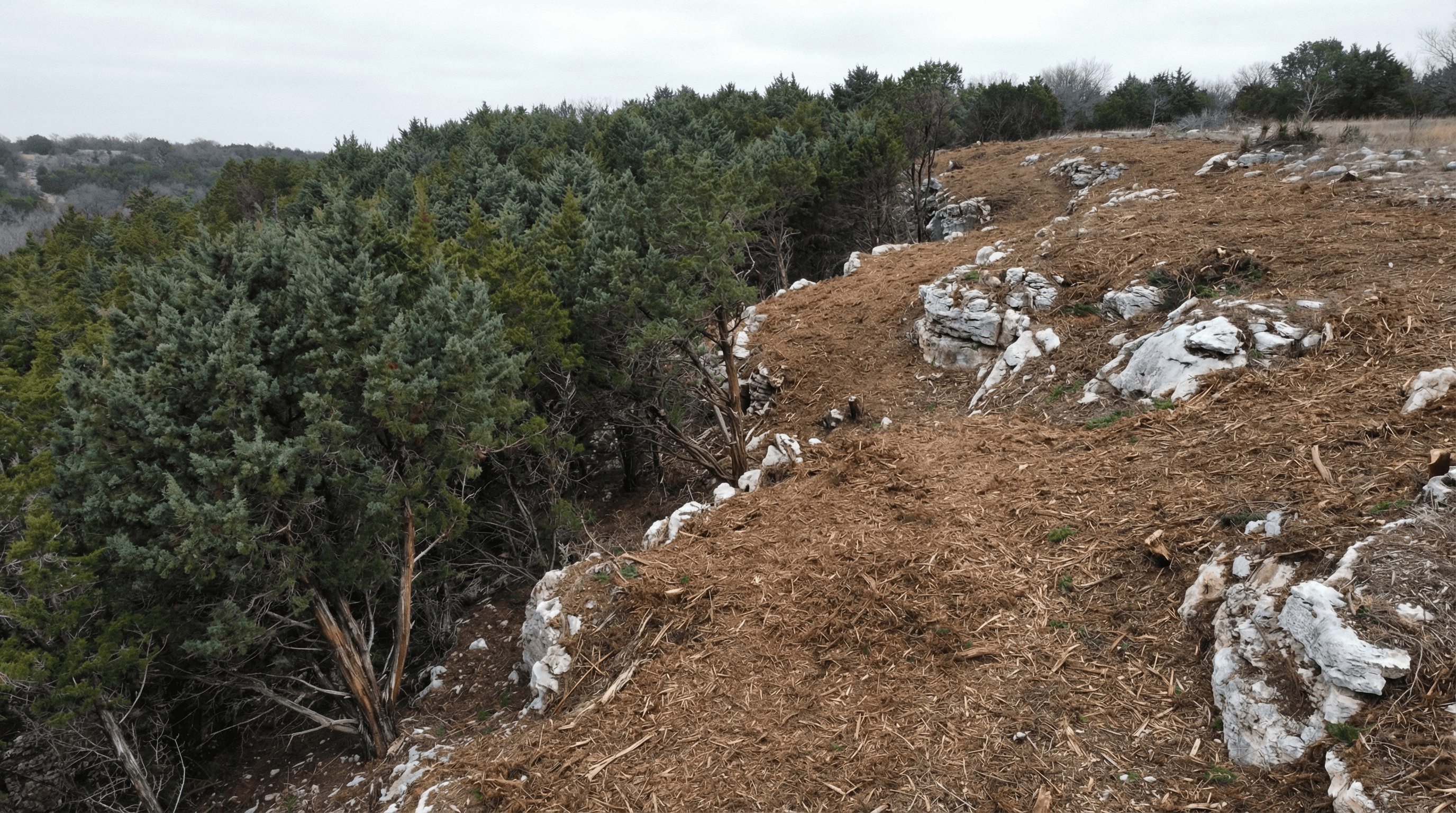
Take Your Water Back
Cedar and Mesquite Removal in Parker County
Cedar drinks 30-40 gallons of water per day and kills everything around it. Mesquite resprouts from roots you cannot reach. We remove both. Your land gets its water back.
Sound Familiar?
Your stock tank is lower every year and the creek that used to run year-round dried up five years ago.
The pasture that used to support 20 head now struggles with 8 because cedar has taken over half the grazing land.
You cannot walk 50 feet on your own property without pushing through cedar branches.
Your well driller said the water table has been dropping and he cannot explain why.
Every December your entire family gets hit with cedar fever and you are tired of it.
How Cedar Removal Works
Free Estimate
We walk your property and assess cedar density, tree sizes, and mesquite presence. You get a fixed price and a plan for what to cut and what to leave.
We Remove It
Forestry mulching grinds cedar and brush into mulch on-site. Mesquite stumps get chemical treatment to prevent resprouting. One pass through the property.
Your Land Recovers
With cedar gone, water stays in the ground. Grass returns. Springs that went dry may start flowing again. Your land starts working for you instead of against you.
The Cedar Problem in Parker County
Ashe juniper -- what everyone in Texas calls cedar -- is the single most destructive invasive species in the Cross Timbers region. It was not always this bad. Before settlement, periodic wildfires kept cedar confined to limestone bluffs and canyon walls where fire could not reach. Once the fires stopped, cedar moved into every acre of open ground it could find.
Here is what cedar does to your property:
- Drinks 30-40 gallons of water per day per mature tree through transpiration. A dense cedar stand of 200 trees per acre removes 6,000-8,000 gallons of water per day from your land. That water never reaches your well, your stock tank, or your grass roots.
- Intercepts 30-50% of rainfall before it hits the ground. Cedar canopy is so dense that light rain evaporates off the needles before it drips through. Only heavy rain makes it to the soil surface.
- Reduces grazing capacity by 80%+. Grass cannot grow under cedar canopy. No sunlight, no water, no grass. An acre of dense cedar supports almost zero grazing.
- Volatile oils are a fire hazard. Cedar burns hot and fast. A cedar fire throws embers hundreds of feet. Dense cedar thickets next to your house or barn are a serious risk.
- Depresses property values 20-40%. Buyers looking at raw land in Parker County know what cedar costs to clear. Cedar-choked acreage sells for significantly less than cleared or open land.
The one piece of good news: cedar does not resprout from roots. Cut it at the trunk and it dies. That makes forestry mulching extremely effective for cedar removal. One pass through the stand and the cedar is permanently gone.
The bad news: cedar seedlings are aggressive. Texas A&M research at the Sonora and San Angelo research stations documented 260 to 1,469 new seedlings per acre within 3 years of clearing. The mulch layer from forestry mulching suppresses germination for 1-3 years. After that, plan on a maintenance clearing every 6-8 years to keep cedar from reestablishing. It is still worth doing -- the water savings alone pay for the clearing within a few years on most properties.
The Mesquite Problem
Mesquite is a different animal than cedar. Where cedar dies when you cut it, mesquite comes back. The underground bud zone -- a swollen root crown sitting 2-6 inches below the soil surface -- sends up new shoots within weeks of the trunk being cut. A single mesquite tree can have lateral roots extending 50 feet in every direction, pulling water from a massive area.
Mature mesquite uses roughly 20 gallons of water per day. The root system is so extensive that mesquite can tap water sources other plants cannot reach, which is why it thrives in drought while everything else dies. The thorns are vicious -- 2-3 inch spikes that puncture tires, boots, and livestock hooves.
Removing mesquite requires a two-step approach:
- Forestry mulching to grind the above-ground growth. This removes the canopy, stops transpiration, and opens the land to sunlight and grass.
- Chemical stump treatment applied immediately after cutting. The herbicide travels through the vascular system to the bud zone and kills it. Without this step, the mesquite resprouts and you are back to square one.
Even with chemical treatment, some mesquite will survive and require follow-up. Mesquite is harder and more expensive to permanently eliminate than cedar. We are honest about that upfront. But reducing the mesquite population by 80-90% still makes a significant difference in water availability and grazing capacity.
Other Problem Species We Remove
Greenbriar & Catclaw
Thorny vines that make a property unwalkable. Both resprout from roots, but the mulch layer suppresses regrowth for 1-3 years. Greenbriar is common in the creek bottoms and shaded areas east of Weatherford. Catclaw thorns are curved and grab anything that touches them.
Prickly Pear
Spreads by fallen pads -- each pad that touches soil can root and grow a new plant. The mulching head grinds prickly pear into fragments that decompose under the mulch layer. Prickly pear is especially thick on the limestone and caliche soils west of Weatherford.
Honeysuckle
Japanese honeysuckle smothers native vegetation in riparian areas and creek bottoms. It climbs trees, blocks sunlight, and kills the plants it grows over. Common along the Brazos tributaries and creek drainages throughout Parker County.
Hackberry & Elm Understory
Cedar elm and hackberry saplings fill the understory under mature oaks. Removing this understory opens the canopy, lets grass grow, and gives your hardwoods room to mature. We leave the big oaks and remove the crowding beneath them.
What Happens After Cedar Removal
Reclaim Your Water
A single mature cedar drinks 30-40 gallons of water per day. Remove 100 cedars and that is 3,000-4,000 gallons per day back in your soil and water table.
Cedar Stays Dead
Unlike mesquite, cedar (Ashe juniper) does not resprout from roots. Cut it at ground level and it is gone for good. That is the one piece of good news about cedar.
Reduce Fire Risk
Cedar has volatile oils that burn hot and fast. Dense cedar thickets are a fire hazard. Removing cedar reduces your fire risk and protects the hardwoods you want to keep.
Increase Property Value
Cedar-choked land sells for 20-40% less than cleared land in Parker County. Clearing cedar is one of the highest-return improvements you can make on raw acreage.
Kill the Allergy Factory
Cedar pollen (mountain cedar fever) hits every December through February. Fewer cedars on your property means less pollen drifting into your house.
Year-Round Service
Forestry mulching works during burn bans, in summer heat, and through winter. October through March is ideal for cedar removal, but we clear year-round.
Cedar Removal Pricing
Pricing depends on cedar density, tree size, terrain, and accessibility. Mesquite removal includes chemical stump treatment.
Light Cedar
Scattered cedar trees, mostly open ground between them
$2,500 - $3,500
per acre
Moderate Cedar
Noticeable canopy cover, multi-trunk trees, mixed brush
$3,500 - $4,500
per acre
Dense Thickets
Closed canopy, cannot walk through it, heavy undergrowth
$4,500 - $5,500+
per acre
Mesquite removal with chemical stump treatment may add to the cost. These ranges are guidelines based on typical Parker County properties -- not quotes. Final pricing requires an in-person site visit. Every estimate is free. See our full pricing page for more detail.
Cedar in Parker County: What You Are Dealing With
Parker County sits at the western edge of the Cross Timbers, where the post oak savannah transitions into limestone rangeland. This is prime cedar territory. The Ashe juniper population has expanded dramatically over the last 50 years as fire suppression allowed seedlings to establish in open grassland and oak understory.
The worst cedar concentrations in the county are on the limestone and caliche soils west and southwest of Weatherford, along the Brazos River tributaries, and on the rocky hilltops where fire historically could not carry. But cedar has now moved into the sandy loam areas around Azle and Springtown too.
The average parcel in Parker County is 1.01 acres. A lot of our customers have 1-5 acre properties where cedar has taken over a significant portion of the usable land. At those sizes, the per-acre cost of clearing is higher but the total job cost is manageable. We also handle 20, 50, and 100+ acre ranch clearing projects where volume pricing makes the per-acre cost considerably lower.
If you are not sure whether your property has a cedar problem or a mesquite problem or both, contact us for a free walk-through. We will tell you exactly what is growing on your land and what it will take to clear it.
Frequently Asked Questions
Stop Feeding the Cedar
Every day you wait, each cedar on your property drinks another 30-40 gallons of your water. Get a free estimate and take your land back.