
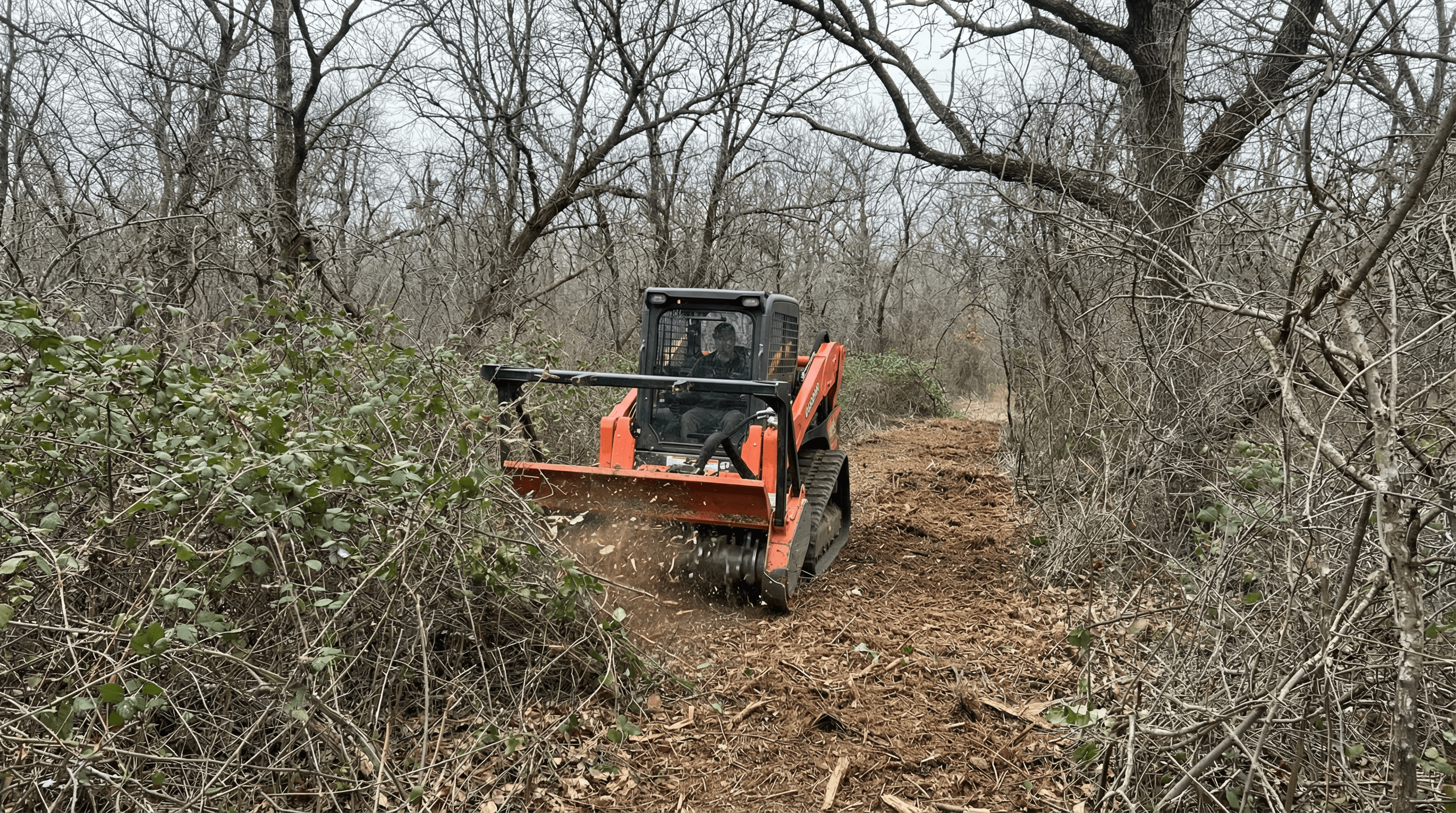
Undergrowth Removal
Brush Clearing in Parker County
Dense undergrowth turns usable acreage into impassable thicket. We grind it down, mulch it in place, and give you your land back. Greenbriar, yaupon, prickly pear, sumac — all of it.
Sound Familiar?
“I bought 5 acres and half of it is impassable.”
We hear this constantly. Someone buys acreage in Parker County, walks the property line, and realizes a significant portion of their land is a wall of thorns and brush they can not walk through, let alone use. The aerial photos looked fine. On the ground, it is a different story.
Parker County sits in the Cross Timbers ecoregion — a transitional zone where the Eastern deciduous forest meets the Western grasslands. That means dense post oak woodland interspersed with prairie. The understory in the wooded areas gets thick fast, and the species that fill it in are some of the most aggressive brush types in Texas.
You can not fix this with a chainsaw and a weekend. These are thorny, dense, interlocking species that grow back from the roots. Hand-clearing an acre of greenbriar and yaupon takes a crew days of miserable work. A forestry mulcher does it in hours and leaves a mulch layer that slows regrowth.
That is the difference between fighting brush and actually clearing it.
How It Works
From Thicket to Open Ground
Assess the Brush
We walk your property, identify the brush species and density, flag any trees you want to keep, and note terrain challenges like rocky ground or slopes. You get a fixed-price quote.
Mulch It Down
Our forestry mulcher grinds everything at ground level. Brush, saplings, vines, small trees — it all becomes mulch. Larger trees over 6-8 inches get chainsaw prep first, then the mulcher processes the rest.
Walk Your Land
When we are done, you can walk every acre of your property. The mulch layer stays in place, suppresses regrowth, and breaks down into the soil over time. No hauling, no burn piles.
Why Clear Brush
What You Get
Usable Acreage
Land you own but can not use is wasted money. Clearing brush gives you back every square foot you paid for.
Fire Risk Reduction
Dense dry brush is fuel. Clearing undergrowth reduces wildfire risk to your structures and your neighbors.
Healthier Trees
Brush competes with your good trees for water and sunlight. Clear the undergrowth and the trees you keep do better.
Erosion Control
The mulch layer left behind protects topsoil from rain erosion far better than bare dirt from traditional clearing.
Suppressed Regrowth
A 3-4 inch mulch layer buys you 2-4 years before brush pushes through again. Way longer than hand-clearing or burning.
No Debris to Haul
Everything stays on-site as mulch. No burn piles waiting for permits. No dump truck loads. The debris becomes soil amendment.
What We Clear
Parker County Brush Species
The Cross Timbers ecoregion produces some of the most stubborn brush in North Texas. Here is what we deal with regularly.
Greenbriar / Catclaw
Thorny vines with curved barbs that catch on clothing, skin, and equipment. Forms impenetrable tangles. The number one reason people call us.
Yaupon Holly
Evergreen shrub that forms dense thickets in the understory. Grows 15-25 feet tall. Shade-tolerant, which means it thrives under the tree canopy where nothing else grows.
Flame-leaf and Skunkbush Sumac
Fast-growing shrubs that colonize disturbed ground and field edges. Spreads via root suckers, so a single plant becomes a colony quickly.
Prickly Pear Cactus
Spreads via dropped pads on rocky, thin-soil areas. Common on limestone outcrops in western Parker County. Each pad that hits the ground roots and grows a new plant.
Hackberry Seedlings
Birds spread hackberry seeds everywhere. Seedlings sprout thick under fence lines and around structures. Fast-growing and persistent.
Lotebush and Elbowbush
Thorny native shrubs common in the Cross Timbers understory. Dense branching makes them difficult to clear by hand. The mulcher handles them in a single pass.
Equipment and Terrain
What We Can and Cannot Mulch
Handles in One Pass
Brush and saplings up to 6-8 inches in diameter
Thorny vines including greenbriar and catclaw
Dense understory shrubs like yaupon and sumac
Prickly pear patches on accessible ground
Hackberry and cedar seedlings
Needs Chainsaw Prep First
Trees larger than 8 inches in diameter need to be felled and bucked with a chainsaw before the mulcher processes them. This is standard procedure for any lot with mature timber. We handle the chainsaw work as part of the job.
Terrain Considerations
Rocky limestone areas with shallow topsoil increase equipment wear and slow the work. North Texas clay soil gets soft when wet and rock-hard when dry — we schedule around weather accordingly. Sandy loam areas in eastern Parker County are the easiest terrain to work.
Soil and Terrain
How Parker County Soil Affects Clearing
Sandy Loam
Found in eastern Parker County. Easiest to work. Equipment moves well, mulcher teeth last longer. Brush regrowth is moderate since the soil drains well.
North Texas Clay
Dominant soil type across much of the county. Soft and slick when wet, concrete-hard when dry. We schedule around rain events. Heavy equipment can rut wet clay, so timing matters.
Limestone / Caliche
Common in western Parker County toward Mineral Wells. Shallow topsoil over rock. Increases wear on mulcher teeth significantly. Priced accordingly.
Frequently Asked Questions
Related Services
Ready to reclaim your overgrown acreage?
Tell us the acreage and brush conditions. We will walk it and give you a fixed price. Free estimates, no obligation.