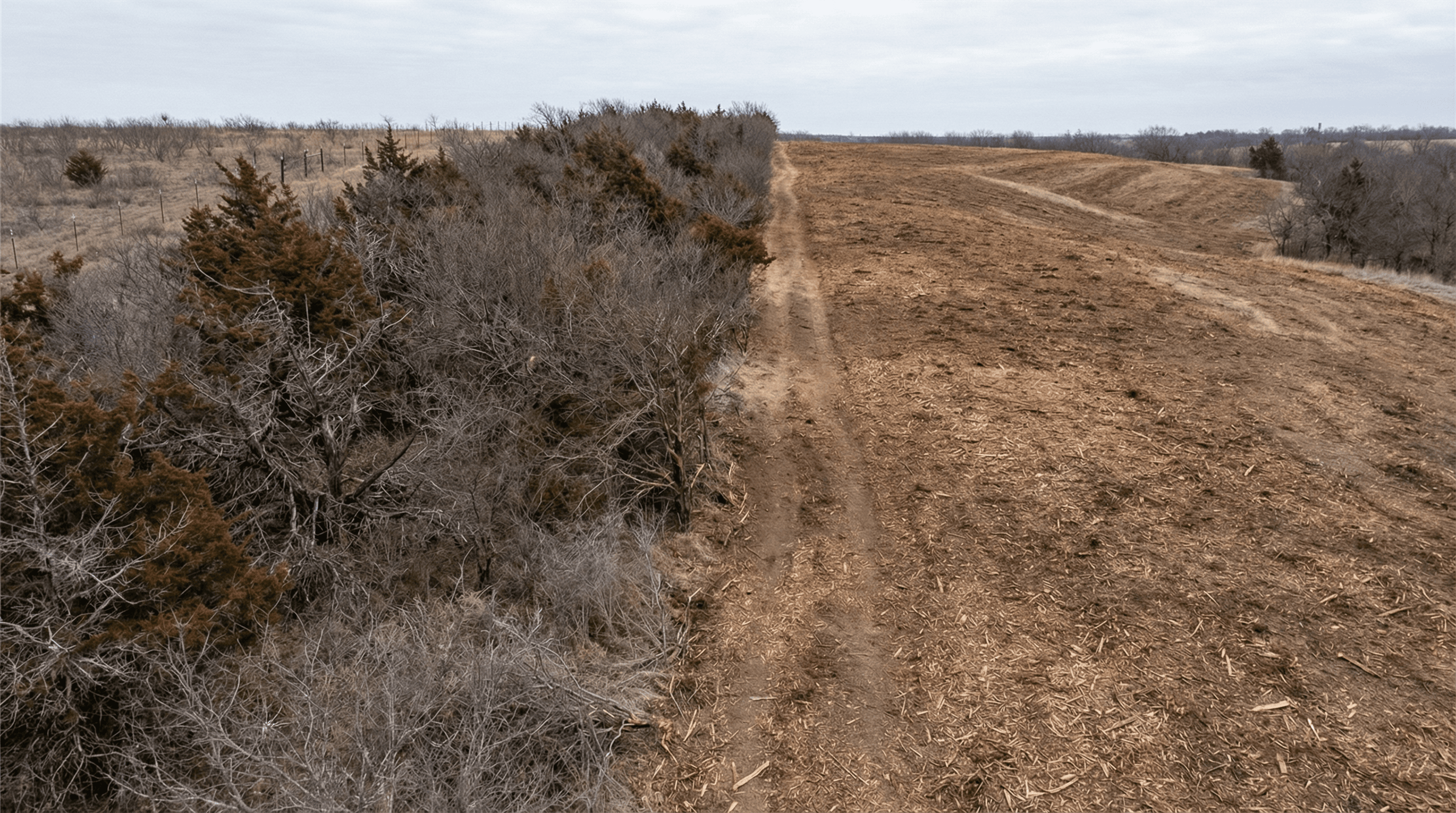
Professional Land Clearing
Land Clearing in Parker County, Texas
Forestry mulching for lots, acreage, and construction sites across Parker County. One machine, one pass. No burning, no hauling, no mess. Just cleared land you can actually use.
Sound Familiar?
You bought acreage but can't walk 20 feet without hitting cedar, greenbriar, and deadfall.
Your builder needs the lot cleared before construction starts and the permit clock is ticking.
You're paying property taxes on land you can't even see from your driveway.
The county sent you a notice about overgrown vegetation and you need it handled fast.
You want to run cattle or horses but the brush has taken over every inch of usable pasture.
How It Works
Free Estimate
We walk your property, assess the vegetation density and terrain, and give you a fixed price. No surprises.
We Clear It
Our forestry mulching equipment grinds brush, trees, and undergrowth into mulch in a single pass. Most properties take 1-3 days.
You Enjoy It
Walk your land without fighting through brush. Build, graze, garden, or just sit on your porch and see past the tree line for once.
Why Property Owners Choose Forestry Mulching
Selective Clearing
We work around the trees you want to keep. You mark them, we protect them.
No Fire Risk
Forestry mulching works during burn bans. No open flames, no smoke complaints, no permits needed.
Fixed Pricing
You get a number before we start. That number doesn't change. Volume discounts for 5+ acres.
Fast Turnaround
Most residential lots clear in a single day. Larger acreage runs 1-4 acres per day depending on density.
Mulch Stays On-Site
Ground vegetation becomes a 2-4 inch mulch layer that prevents erosion and suppresses regrowth for 1-3 years.
Soil Protection
Unlike dozer work, forestry mulching doesn't strip topsoil or disrupt root networks that hold your land together.
Land Clearing in the Cross Timbers
Parker County sits in the Western Cross Timbers ecoregion, which means the native vegetation is dense, thorny, and aggressive. The dominant species here are post oak, blackjack oak, cedar elm, and hackberry, with a thick understory of Ashe juniper (cedar), greenbriar, prickly pear, and honey mesquite. Left alone, this stuff takes over a property in 5-10 years.
The average parcel size in Parker County is 1.01 acres -- roughly five times the Texas state average. That is a lot of land to lose to brush. Most property owners we work with have 1-10 acres that need clearing, though we regularly handle 20, 40, and 100+ acre projects for ranchers and developers.
Soil types across Parker County vary from sandy loam on the east side near Azle and Springtown to heavy clay around Weatherford and Aledo. Some areas west of Weatherford hit limestone and caliche within a few feet of the surface. These soil conditions matter for clearing because they affect root depth, equipment access, and what you can do with the land after it is cleared.
Sandy loam drains fast and supports post oak savannahs. Clay soil holds water and tends to grow thicker brush. Limestone outcrops create shallow root systems that make trees easier to mulch but harder to grade. We adjust our approach based on what your property is actually sitting on.
What We Clear
Our forestry mulching equipment handles the full range of vegetation you will find on Parker County properties:
- Cedar (Ashe juniper) -- the number one invasive species in the Cross Timbers. Each mature cedar drinks 30-40 gallons of water per day. Cut it and it dies -- cedar does not resprout from roots.
- Mesquite -- lateral roots extend up to 50 feet. Resprouts from an underground bud zone, which makes it harder to kill permanently. We mulch the top growth and can coordinate chemical stump treatment.
- Post oak and blackjack oak understory -- small-diameter oaks and saplings that crowd out mature trees and reduce grazing capacity.
- Greenbriar and catclaw -- thorny vines that make a property unwalkable. These resprout from roots, but the mulch layer suppresses regrowth.
- Prickly pear -- spreads by fallen pads. Mulching grinds it down and the pad fragments decompose under the mulch layer.
- Deadfall and debris -- storm damage, fallen limbs, and old brush piles get processed into mulch along with everything else.
Trees up to 6-8 inches in diameter go through the mulching head. Larger trees can be felled and then mulched, or left standing if you prefer selective clearing. Most cedar removal jobs fall well within our equipment range since cedar rarely exceeds 8-10 inches in trunk diameter.
Land Clearing Pricing
Pricing varies by vegetation density, tree diameter, terrain, and access. These ranges reflect typical Parker County properties.
Light Brush
Grass, weeds, small saplings, scattered brush under 3 inches
$1,500 - $2,500
per acre
Medium Density
Mixed cedar, mesquite, and oak with trees up to 6 inches
$2,500 - $4,500
per acre
Heavy / Timber
Dense cedar thickets, large-diameter trees, heavy undergrowth
$4,500 - $7,000+
per acre
Volume discounts available for properties over 5 acres. Every estimate is free and based on an in-person site visit. Final pricing depends on actual conditions -- these ranges are guidelines, not quotes. See our full pricing page for more detail.
Frequently Asked Questions
Related Services
Ready to Clear Your Land?
Get a free estimate for your Parker County property. We'll walk your land, give you a fixed price, and get it done.